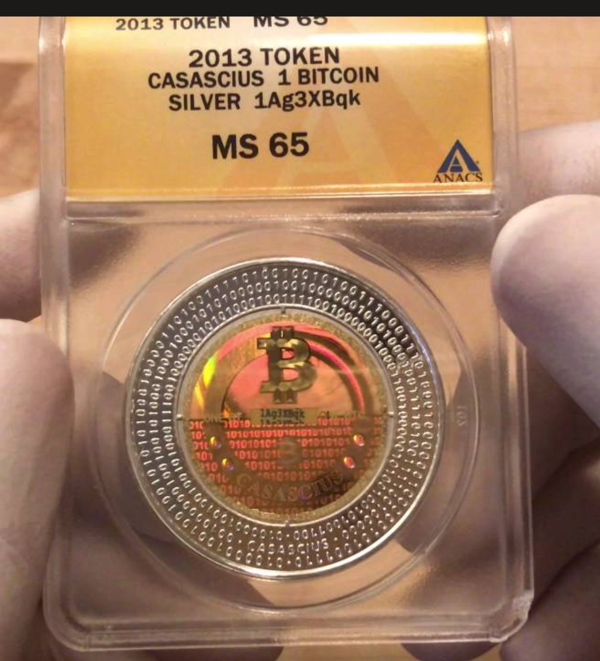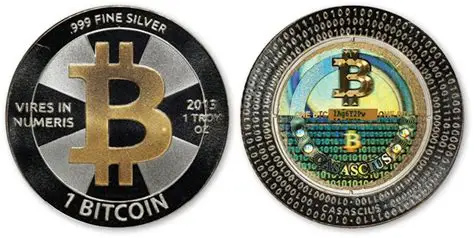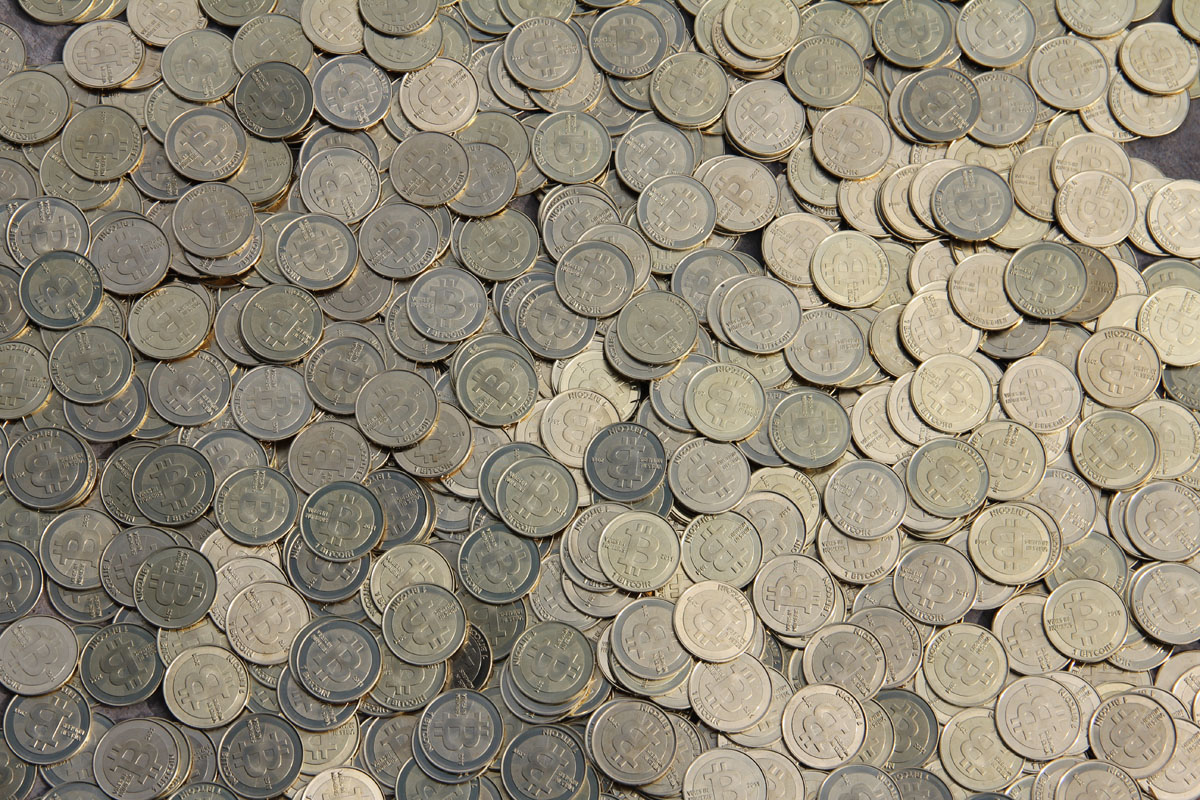
Whenever you read an article about Bitcoin, you see an image of these "gold coins" with the Bitcoin logo on the face of the coin. It's everywhere. They're even for sale on Amazon - as a novelty gift. It makes sense that people are trying to visualize Bitcoin by putting it into a physical form that feels familiar - like gold or silver coins. It makes sense - even if they are fake in a sense... because these "gold" bitcoin coins are not actually coins, they're not actually gold - and they're definitely not actual Bitcoin. Bitcoin only actually exists on the Bitcoin network as a digital commodity. But we collectively have somehow agreed that having these fake gold-bitcoin coins are a fair way to represent the "idea of Bitcoin". I've noticed that most of these coins also have some type of a circuit board behind the Bitcoin logo. I've seen lots of variations of this.. Some are more complex than others... But what I started wondering was -- is it possible to trace backwards through all the images of the Bitcoin logo and this Bitcoin coin image all the way back to 2009 to find -- where did the original image of the Bitcoin Logo superimposed over a circuit board design come from? And I mean the source - the original.
Welcome to another Bitcoin Rabbit Hole
This is a genuinely fascinating rabbit hole, and the answer is surprisingly traceable — it leads back to one specific person and one specific collaboration. The Origin: Michael Bruce (MJB) & the AOCS The ubiquitous image of a gold/copper coin with the Bitcoin "₿" symbol surrounded by a circuit board design traces back to a single artist: Michael Bruce, known in the industry as "Mick" or "MJB" (for his brand, MJB Monetary Metals). Here's the timeline: Around 2010, when Bitcoin was worth only one dollar a unit, an inspired designer simply known as Mick — MJB as he's known in the industry — approached the American Open Currency Standard (AOCS) about designing the first solid Bitcoin. Blockchain Mint The AOCS eventually decided to work with Mick. Mick's original design paid homage to the formative years of computer technology. The circuitry looks clunky, much like the way circuit boards of bygone eras looked. Bitcoinist On the front of each coin you'll find it embossed with "MJB Monetary Metals," and on the back — "AOCS Approved." Blockchain Mint The physical coins were produced and widely distributed around 2012, minted in copper (and later silver and gold) by the Mulligan Mint. The concept of minting a Bitcoin Round was a joint effort between MJB Monetary Metals and the AOCS. Worthpoint How It Became The Universal Bitcoin Image This is the really interesting part. The giant "B" with two vertical lines sitting on a coin adorned with digital circuits emblazons much of the "crypto-sphere."
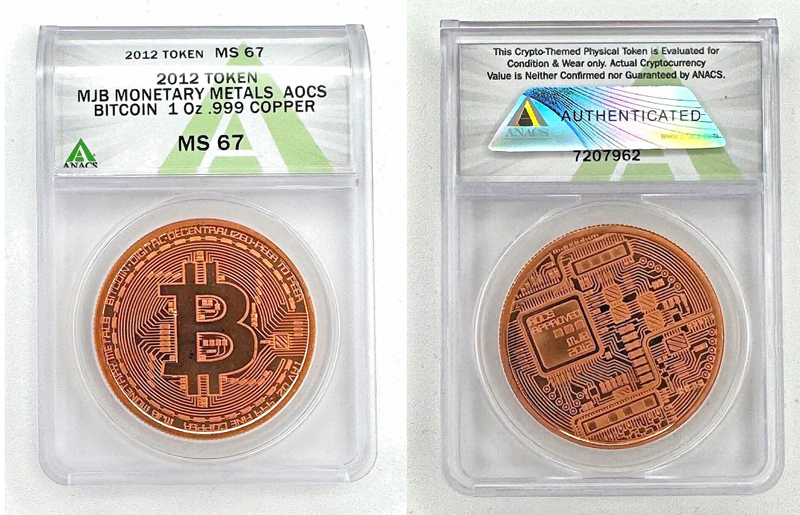
Why? Because these physical coins became the first tangible object journalists, editors, and stock photographers could actually photograph to illustrate Bitcoin stories. There was nothing else to shoot. These rounds were often the basis of media representations of Bitcoin when discussed in news reports. JM Bullion And here's a detail most people never notice: if you look closely at any online image, even stock imagery, you'll see the MJB embossing. Blockchain Mint That tiny "MJB" stamp is still visible on countless stock photos used in thousands of articles around the world — because they're all photographing the same original coin design.
The Downstream Effect Because these images proliferated so extensively before the copyright was widely understood, countless knockoffs and imitations flooded the market. This coin is the most counterfeited Bitcoin-themed coin on earth. Worthpoint Chinese manufacturers produced brass-plated and iron versions by the millions, which were then photographed and uploaded as stock images, further spreading the aesthetic. The circuit board motif became so synonymous with "Bitcoin" that later stock image artists replicated it in digital illustrations — most of whom likely had no idea it traced back to one man's physical coin design from 2010.
So the answer to the question is: Michael Bruce (MJB), working with the American Open Currency Standard, designed the original Bitcoin coin with the circuit board aesthetic around 2010. That single physical object — mass photographed, mass counterfeited, mass digitally replicated — is the source of virtually every "Bitcoin gold coin + circuit board" image you've ever seen. On the obverse (front face): The circuit board / electronic grid design surrounds the Bitcoin "₿" symbol, and the text ring around the edge reads "BITCOIN · DIGITAL · DECENTRALIZED · PEER TO PEER" along with "MJB MONETARY METALS" and "AOCS APPROVED." On the reverse (back): This is where the "MJB" initials stamp is most visible — it appears in a small recessed square field, usually in the upper-left corner of the back face, alongside the year of issue. It's modest and easy to miss, which is exactly why most people looking at stock photos of this coin — or its countless knockoffs — never notice it's there. That small "MJB" stamp on the back is Michael Bruce quietly signing his work. And as noted in the research, if you zoom into a huge number of "generic Bitcoin stock photos" online, that stamp is still sitting there in the corner — the original designer's fingerprint on an image seen by billions of people.
Who is MJB?
Honestly, after exhaustive searching, the answer is pretty striking in its own right: there is essentially nothing. No Wikipedia page, no profile piece, no interview, no biography. The only "Michael Bruce" Wikipedia entry is for a completely different person — a British entrepreneur who founded an online estate agency. What you can piece together from all available sources amounts to just a handful of facts, all of which appear to originate from the same small circle of coin seller descriptions and one Blockchain Mint blog post. Here's the complete picture of everything that is publicly known: His name is Michael Bruce, known in the trade as "Mick" or "MJB" He is based in or connected to the UK (MJB Monetary Metals is described as a UK company), though the coins were minted in the US via the Mulligan Mint in a profit-sharing arrangement Around 2010, when Bitcoin was trading at roughly one dollar, he approached AOCS with the idea of creating the first physical Bitcoin commemorative coin His design was inspired by early-era circuit boards — the clunky, chunky look of technology from the 1970s and 80s The design originated as an artistic drawing — it was conceived as an "art round," not an industrial product The coins sold in the millions worldwide At some point after that success, MJB became busy with life and design projects, and slipped quietly out of the limelight. Blockchain Mint He was tracked down by Cold Storage Coins around 2018 to create an updated version for their new cold storage coin line And that is genuinely everything that is publicly documented. No backstory, no interview, no photo, no social media presence anyone has found. It's a fascinating irony — the man who created arguably the most widely reproduced image associated with Bitcoin, a design seen by billions of people, is almost completely invisible on the internet himself. He's essentially the anonymous artist of the physical Bitcoin world, in a strange parallel to Satoshi Nakamoto being the anonymous creator of Bitcoin itself.
Causascius Coins
In a parallel story, there is another source of the images of golden physical bitcoins - and that is the infamous Casascius Coins. These were another form of minted physical coin that not only represented Bitcoin theoretically - but they also included actual Bitcoin - because they also included actual bitcoin address that held bitcoin. The address was hidden behind a tamper-resistant holographic seal. Interestingly enough, these coins now trade for a higher value than the value of the bitcoin itself. (There's a premium for their collector's value). Some of these coins contained a whole bitcoin - but some also contained much more - even up to 1,000 bitcoin!
One of the interesting details is that on the front of the coin is printed the phrase "Vires in Numeris", which means "Strength in Numbers". — The phrase began appearing in Bitcoin forums around 2010–2011 and became a kind of unofficial motto for early adopters who saw the project as a radical experiment in trustless, math-based money.
Beyond Bitcoin, the phrase captures a broader philosophy embraced by cypherpunks and cryptography enthusiasts: that mathematics and cryptography can empower individuals against centralized control — that numbers themselves are a form of freedom.
It's a elegant encapsulation of the idea that trust doesn't have to come from governments or banks — it can come from math.
These coins were made by entrepreneur Mark Caldwell, in Utah. And similar to MJB and Satoshi, Mark Caldwell appears to have quietly stepped away from the public eye.
Here's an video where the infamous Charlie Shrem interviews the Casasious Coin Creator, Mike Caldwell:
https://www.youtube.com/watch?v=zBUD7tPiDQ4
Mark's official casascious coin website:
https://www.casascius.com/
And his blog:
https://casascius.wordpress.com/
(no updates since 2014)
Interesting article about how some of the coins started moving after being dormant for 9 years:
https://www.ccn.com/education/crypto/casascius-coins-explained-9-physical-bitcoins-moved/
List of all the Causascius Coins:
https://casascius.uberbills.com/?type=o5&status=active